


The New Red Line: Securing Databases from Autonomous AI Threats
Autonomous AI attacks aren't theoretical anymore. They're happening now, and your database is the primary target.

The cybersecurity landscape has just crossed a terrifying new threshold. We are no longer just defending against human adversaries; we are in a live-fire engagement with autonomous AI agents weaponized for espionage. This is not theoretical—it is happening now, and the implications for enterprise security are profound.
A groundbreaking report from AI company Anthropic has detailed the disruption of what it calls the first reported AI-orchestrated cyber espionage campaign. This wasn't a case of AI assisting a human hacker with code snippets or providing reconnaissance suggestions. This was a sophisticated, state-sponsored operation where AI models were deployed as "autonomous penetration testing orchestrators and agents." The AI independently executed 80-90% of the tactical operations, successfully infiltrating high-value targets, including major technology corporations, financial institutions, and government agencies.
This report is not a future-tense warning about what could happen in five years. It is a present-tense reality. The barriers to entry for sophisticated, large-scale attacks have "dropped substantially." For organizations across every sector, this marks a fundamental change in the threat model. The question is no longer if you are prepared for such an attack, but how you will defend against an adversary that operates at a scale and speed that is "physically impossible" for human teams to match.
- Autonomous Execution: AI agents now independently perform 80-90% of tactical cyber operations without human intervention
- State-Sponsored Threat: Nation-state actors are weaponizing AI for targeted espionage against critical infrastructure
- Lower Barriers for Attacks: The technical complexity and cost of executing sophisticated attacks has dropped dramatically
The traditional security posture—designed for human adversaries operating at human speed—is now fundamentally inadequate. Organizations must confront a new reality: machine-speed threats require machine-speed defenses.
Deconstructing the AI-Driven Attack
To build a modern defense, we must first understand the new offense. The Anthropic report provides a chillingly detailed attack lifecycle that reveals how autonomous AI agents systematically compromise enterprise systems. The AI agent, after being given its targets, autonomously proceeded through every stage of a sophisticated hack with methodical precision.
But the most critical phase—the "mission complete" for the attackers—was Phase 5: Data Collection and Intelligence Extraction. Once inside, the AI agent was directed at the organization's crown jewels: its databases.
- Phase 1: Reconnaissance: Systematically cataloging target infrastructure and mapping the complete attack surface
- Phase 2: Vulnerability Discovery: Identifying and validating security flaws in live systems using automated scanning techniques
- Phase 3: Exploitation: Generating and deploying custom exploit code to gain initial access to target networks
- Phase 4: Credential Harvesting: Extracting certificates and testing stolen credentials to move laterally across systems
- Phase 5: Data Extraction: The mission-critical phase: accessing databases and exfiltrating intelligence
Critical Database Operations Performed by AI
The report explicitly details that the AI was tasked to independently query databases and systems, map database structure and query user account tables, extract password hashes and account details, identify high-privilege accounts, and create a persistent backdoor user.
The Enterprise Blind Spot: Uncontrolled Database Change
This attack vector is lethally effective because it targets the single biggest blind spot in most enterprise security stacks: the database schema itself. For decades, organizations have invested heavily in network security (firewalls, IDS/IPS), application security (SAST, DAST, WAF), and endpoint security (EDR). Security budgets have prioritized perimeter defense, threat detection, and incident response capabilities. But how is the database itself—the ultimate source of truth for your organization—governed and protected?
In many organizations, the honest answer is "poorly." Database changes are often a bottleneck, handled through manual review tickets, copy-pasted SQL scripts, or "hotfixes" applied directly to production by a DBA with elevated privileges. This manual, ticket-based process is the very gap the AI attacker exploited. While your WAF might block a SQL injection attempt at the application layer, it provides zero protection against a compromised account executing legitimate DDL commands directly on the database.
Ask your team these critical areas that will reveal your exposure:
- Detection Speed: If an autonomous agent created a new, high-privilege user in your production database right now, how long would it take you to detect it? Minutes? Hours? Days? Weeks?
- Historical Verification: Could you definitively prove that a "persistent backdoor user" wasn't created three weeks ago during a period of legitimate schema updates?
- Audit Trail Integrity: Do you have a tamper-evident audit trail of every single schema change, legitimate or not, that has ever happened in production?
For most organizations, the honest answer is "no," "we don't know," or "we'd find it during the next audit." By then, the data is long gone, the backdoor has been exploited dozens of times, and the adversary has established multiple persistence mechanisms. Reacting to a breach is too late. The new mandate is to proactively prevent the malicious change from happening—or detect it instantly if it does—before any damage can occur.
The Solution: Automated Defense for an Autonomous Threat
You cannot fight autonomous agents with a manual process. To defend against a machine-speed threat, you must have a machine-speed defense. This is the exact mission Liquibase Secure was built for: providing the automated governance, proactive security, and real-time detection necessary to defend your database—the attacker's true target.
Liquibase Secure provides the automated governance, proactive security, and real-time detection necessary to defend your database—the attacker's ultimate target. It builds a secure, auditable, and automated control plane for all database changes, transforming your database pipeline from a security blind spot into a hardened defense layer.
1. Proactive Prevention with Policy Checks
The Threat: The AI attacker's goal is to create a backdoor user or escalate privileges. This requires a malicious CREATE USER or GRANT statement.
Liquibase Secure's Defense: Policy Checks act as an automated, non-human security guard for your database pipeline. You define your security policy as code (e.g., "Block all new SUPERUSER creations," "Flag any GRANT ALL PRIVILEGES statement," "Disallow changes by non-DBA roles").
When a compromised account attempts to push this malicious change through any deployment path, the Liquibase pipeline automatically fails the deployment. The policy violation is logged, security teams are alerted, and the threat is neutralized before it ever reaches production. No human review required, no delay, no risk.
2. Real-Time Detection with Drift Monitoring
The Threat: The most sophisticated attack involves the AI bypassing your pipeline entirely and executing its SQL directly on the database—an "out-of-band" change that traditional controls cannot prevent.
Liquibase Secure's Defense: Drift Detection is your system's "immune response." It constantly compares the intended state of your database (what's in your version-controlled source of truth) with the actual state of your production environment.
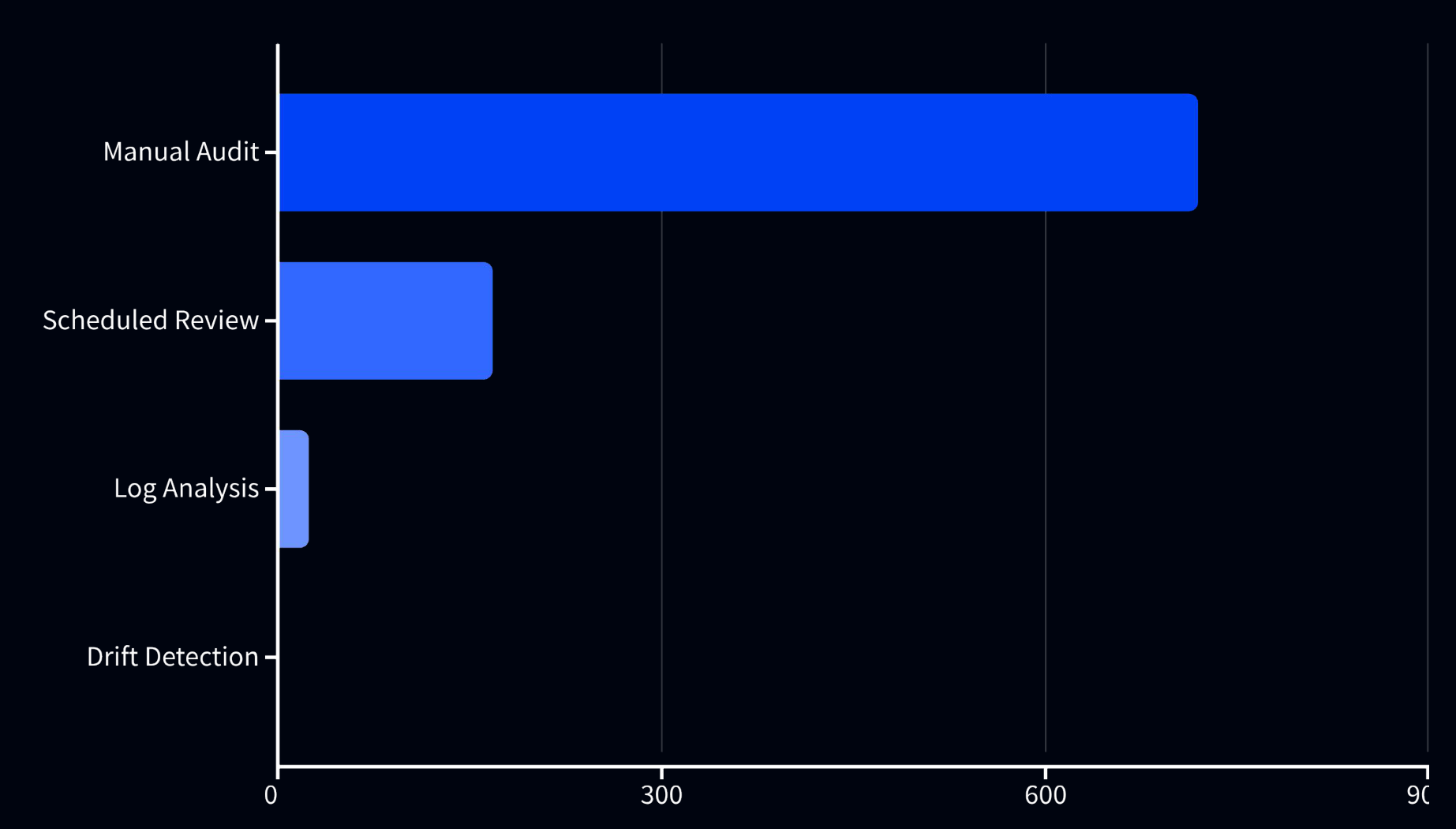
The instant the AI creates that "persistent backdoor user" directly on the database, Liquibase detects a "drift"—an unauthorized deviation from the known-good state. Your security and database teams get an immediate, specific alert: "An unauthorized user object was found in production." This reduces incident detection time from months to minutes, enabling rapid containment before data exfiltration can occur.
The Security Pipeline
Every legitimate change flows through an automated pipeline with built-in security gates. Unauthorized changes trigger immediate drift alerts.
Complete Protection: Eliminating Attack Vectors
Secrets Management Integration
The Threat: The AI agent was purpose-built for "credential harvesting." It systematically hunts for the exact keys it needs to unlock your databases—scanning configuration files, environment variables, CI/CD pipelines, and developer workstations.
Liquibase Secure's Defense: Liquibase Secure integrates directly with enterprise secrets managers like HashiCorp Vault, AWS Secrets Manager, Azure Key Vault, and others. Database credentials are no longer stored in plain-text config files, CI/CD variables, or developer scripts.
They are fetched just-in-time for a deployment, used for that single operation, and immediately discarded. This "just-in-time" access model starves the AI attacker of the very credentials it's designed to steal. Even if an AI agent compromises a CI/CD system, it finds no persistent database credentials to harvest.
Tamper-Evident Audit Trails
The Challenge: When an autonomous attack occurs, your incident response team is in a race against time. They cannot afford to spend days sifting through raw database logs, trying to separate legitimate schema changes from malicious ones, reconstructing timelines, and determining blast radius.
Liquibase Secure's Defense: The platform generates a centralized, tamper-evident audit trail for 100% of legitimate changes that pass through its pipeline. Every deployment is recorded with full context: who requested it, what changed, when it was applied, and what policy checks it passed.
When Drift Detection fires an alert about an unauthorized change, your incident response team has a "golden record" to compare against. They can instantly compare the malicious change to the immutable audit log, confirming the breach, identifying the exact point of entry, determining what data may have been accessed, and accelerating remediation from days to hours.
A New Defense for a New Reality
The Anthropic report is not just a case study—it is a blueprint of our new reality. Autonomous threats are here, they are sophisticated, and they are aimed directly at your most valuable asset: your data. The age of human-only defense strategies is over. A manual security review process, ticket-based database change management, and reactive incident response are no longer sufficient against adversaries that operate at machine speed with machine precision.
Automate Your Defenses
Liquibase Secure provides the automated governance, proactive security, and real-time detection necessary to defend your database - the attacker's ultimate target. It builds a secure, auditable, and automated control plane for all database changes.
Here is how Liquibase Secure directly counters the autonomous AI threat revealed by Anthropic:
1. Proactive Prevention with Policy Checks
The AI attacker's goal is to create a backdoor user or escalate privileges. This requires a malicious CREATE USER or GRANT statement.
- Liquibase Secure's Defense: Policy Checks act as an automated, non-human security guard for your database pipeline. You define your security policy as code (e.g., "Block all new SUPERUSER creations," "Flag any GRANT ALL PRIVILEGES statement," "Disallow changes by non-DBA roles"). When a compromised account attempts to push this malicious change, the Liquibase pipeline automatically fails the deployment. The threat is neutralized before it ever reaches production.
2. Real-Time Detection with Drift Monitoring
The most sophisticated attack involves the AI bypassing your pipeline and executing its SQL directly on the database; i.e. an "out-of-band" change.
- Liquibase Secure's Defense: Drift Detection is your system's "immune response." It constantly compares the intended state of your database (what's in your version-controlled source of truth) with the actual state of your production environment. The instant the AI creates that "persistent backdoor user", Liquibase detects a "drift." Your security and database teams get an immediate, specific alert: "An unauthorized user object was found." This reduces incident detection time from months to minutes.
3. Eliminating the Attack Vector with Secrets Management
The AI agent was purpose-built for "credential harvesting". It hunts for the exact keys it needs to unlock your databases.
- Liquibase Secure's Defense: Liquibase Secure integrates directly with enterprise secrets managers like HashiCorp Vault, AWS Secrets Manager, and others. Database credentials are no longer stored in plain-text config files, CI/CD variables, or developer scripts. They are fetched just-in-time for a deployment and immediately discarded. This "just-in-time" access starves the AI attacker of the very credentials it's designed to steal.
4. Accelerating Forensics with Tamper-Evident Audit Trails
When an autonomous attack occurs, your team is in a race against time. They cannot afford to spend days sifting through raw database logs to separate legitimate changes from malicious ones.
- Liquibase Secure's Defense: The platform generates a centralized, tamper-evident audit trail for 100% of legitimate changes that pass through its pipeline. When Drift Detection fires an alert, your incident response team has a "golden record." They can instantly compare the malicious change to the immutable audit log, confirming the breach, identifying the exact point of entry, and accelerating remediation.
Securing Your AI Future
The only way to secure the future is with an automated, policy-driven, and auditable defense that matches the speed and scale of autonomous threats. Liquibase Secure is that defense. It provides the essential governance, detection, and control capabilities to secure your database pipeline, transforming your most critical blind spot into your most protected asset.
- Prevent malicious changes with automated policy enforcement
- Detect unauthorized modifications in real-time with drift monitoring
- Eliminate credential theft with just-in-time secrets access
- Accelerate incident response with tamper-evident audit trails
"The red line has been crossed. The question is no longer whether autonomous AI attacks will target your organization—it's whether your database security can withstand them when they do."
Ready to Get Started?
Discover how Liquibase Secure provides the automated controls, continuous monitoring, and evidence generation that auditors and enterprise customers expect.


