Introducing Liquibase Secure 6.0
As AI agents take on more of the software delivery lifecycle, including database change, modern governance has to evolve to keep up. Liquibase Secure 6.0 is a unified platform for database change governance, giving enterprises one place to see what is changing, govern how change happens, and control who can change the rules across teams, pipelines, databases, and agents.
September 30, 2026

See Liquibase in Action
Accelerate database changes, reduce failures, and enforce governance across your pipelines.
.svg)

Database change has become an enterprise problem
AI-assisted development, developer self-service, microservices, and modern CI/CD have made software delivery faster than ever. They have also created more database change, across more teams, tools, environments, and now AI agents. Traditional review processes were never built for that volume. AI’s role in the SDLC no longer stops at generating code. Agents are beginning to write and test database changes, run pipelines, monitor deployments, and propose or apply fixes when something fails.
That raises the stakes for the database. Application code can often be redeployed when something goes wrong. A database change that drops a column, rewrites data, or locks a critical table cannot simply be undone. The impact reaches the systems of record the business depends on.
The cost shows up in two places: releases slow down while changes wait for review, and controls are applied inconsistently or skipped altogether. Liquibase Secure 6.0 gives organizations a way to govern database change at enterprise scale, with AI agents working alongside teams rather than around controls.
Liquibase Secure 6.0 brings Database Change Governance to enterprise scale
Liquibase Secure 6.0 introduces a new operating model for database change governance. It helps organizations answer three questions, every day:
What changed? Change Intelligence provides a clear view of the who, what, where, when, and how of database change, along with detailed information about your database estate.
Was it allowed? Change Governance provides centralized policy management, allowing teams to define and apply reusable standards across applications, environments, and delivery workflows. More than 50 prebuilt rules help teams get started, while custom policies support their specific requirements.
Who controls the rules? Role-based access control defines who can manage policies, assignments, exceptions, and governed assets, while automatically maintaining evidence of every change.
What changes at a glance
Together, these capabilities move database governance from individual pipelines to the enterprise. They apply to every change, whether it comes from a developer or an AI agent, from authoring through deployment and remediation.
A unified platform for database change
Liquibase Secure is the unified platform enterprises use to manage and govern database change across the SDLC. It brings database change onto the same path as application code, so changes can be defined, versioned, validated, deployed, and tracked through the tools and workflows teams already use, across 65+ databases.
The platform is organized around three connected capabilities:
- Change Automation: Move database change through CI/CD with developer self-service, golden paths, and targeted rollback.
- Change Governance: Enforce database policies and controls across teams and pipelines, with governed exceptions, access control, and secrets management.
- Change Intelligence: See every database change, understand risk, and know what to do next with deployment visibility, DORA performance, drift detection, and AI-driven remediation.
Earlier this year, Liquibase Secure 5.2 introduced Agent Safe Governance: AI can help author database changes, but it cannot bypass the controls required before production. Liquibase Secure 6.0 extends that principle across the lifecycle, so the same standards, visibility, and ownership apply no matter who or what is testing, deploying, or remediating a change.
What you see, what you enforce, and who controls it are now managed together in a shared visual experience. Developers get guardrails instead of gates. Security and compliance teams get continuous, audit-ready evidence. The business gets predictable change it can trust. See how the pieces fit together.
See every database change with Change Intelligence
Database changes leave a trail across development, testing, production, pipelines, and environments. When something goes wrong, teams often have to follow that trail one source at a time. That slows recovery while an application is down or a release is on hold.
Change Intelligence provides one view of database change across applications, pipelines, teams, and environments. It surfaces deployment activity, environment status, policy outcomes, drift, failures, and change history, helping teams identify where attention is needed before a small issue becomes an outage.
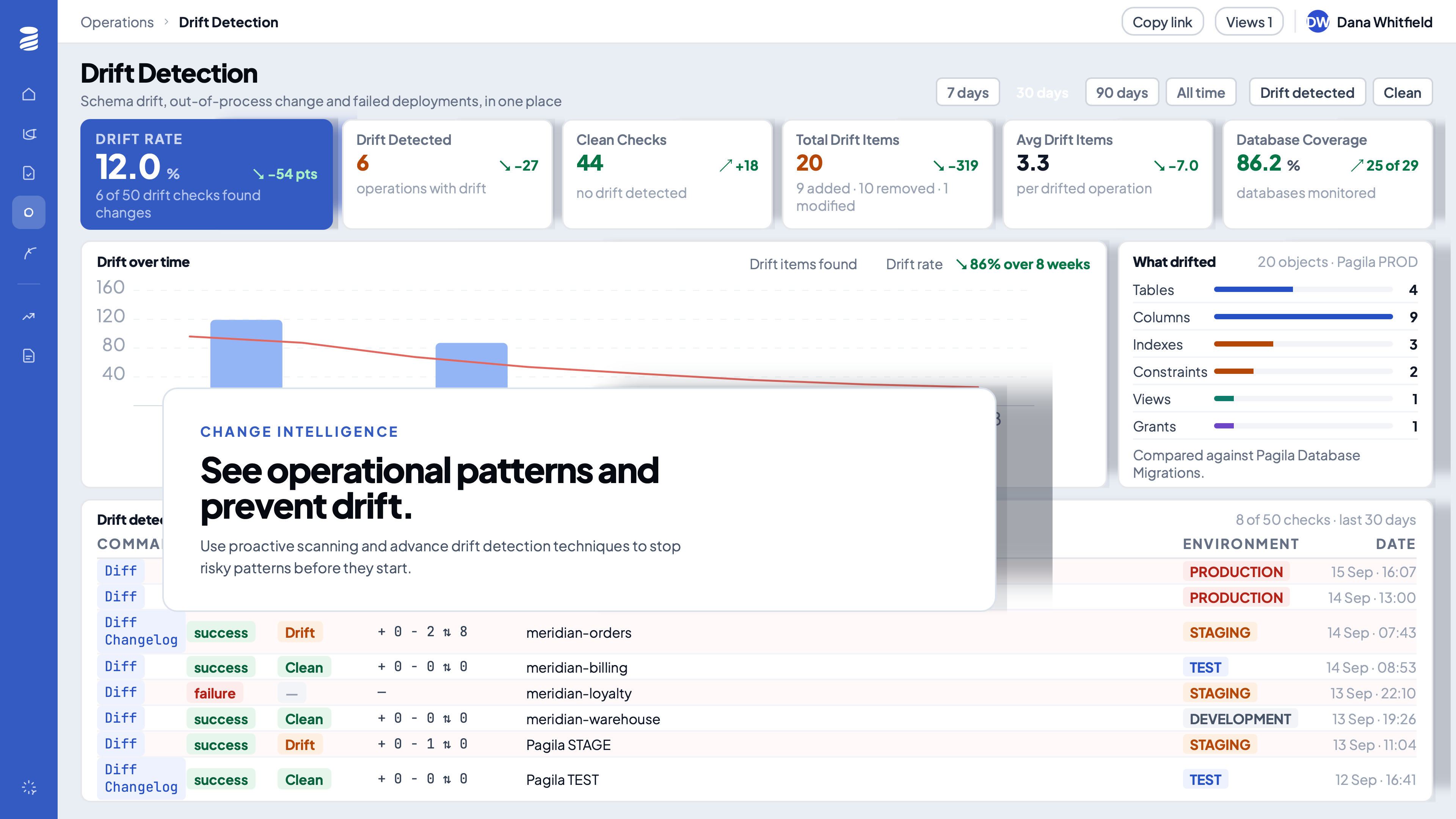
Because deployments through Liquibase Secure are tracked consistently, changes shipped by agents are as visible as changes made by developers.
With Change Intelligence, teams can:
- Monitor database deployments and policy outcomes across the organization.
- Find failures, drift, and other issues without stitching together disconnected logs.
- Use AI-assisted analysis and remediation guidance to resolve deployment failures faster, with the team deciding what gets applied.
The payoff is less time spent collecting information, faster recovery when something breaks, and a consistent record of database change that engineering, security, compliance, and auditors can rely on.
Govern database change from one place
Most enterprises already have database standards. The challenge is applying them consistently across a growing number of teams, applications, pipelines, and database platforms, without forcing every application and environment into the same model.
Liquibase Secure 6.0 introduces a new visual experience for centralized policy management. Rather than editing configuration files and copying them from pipeline to pipeline, teams can define standards once, organize them into reusable policy packages, and assign them across governed assets from one interface.
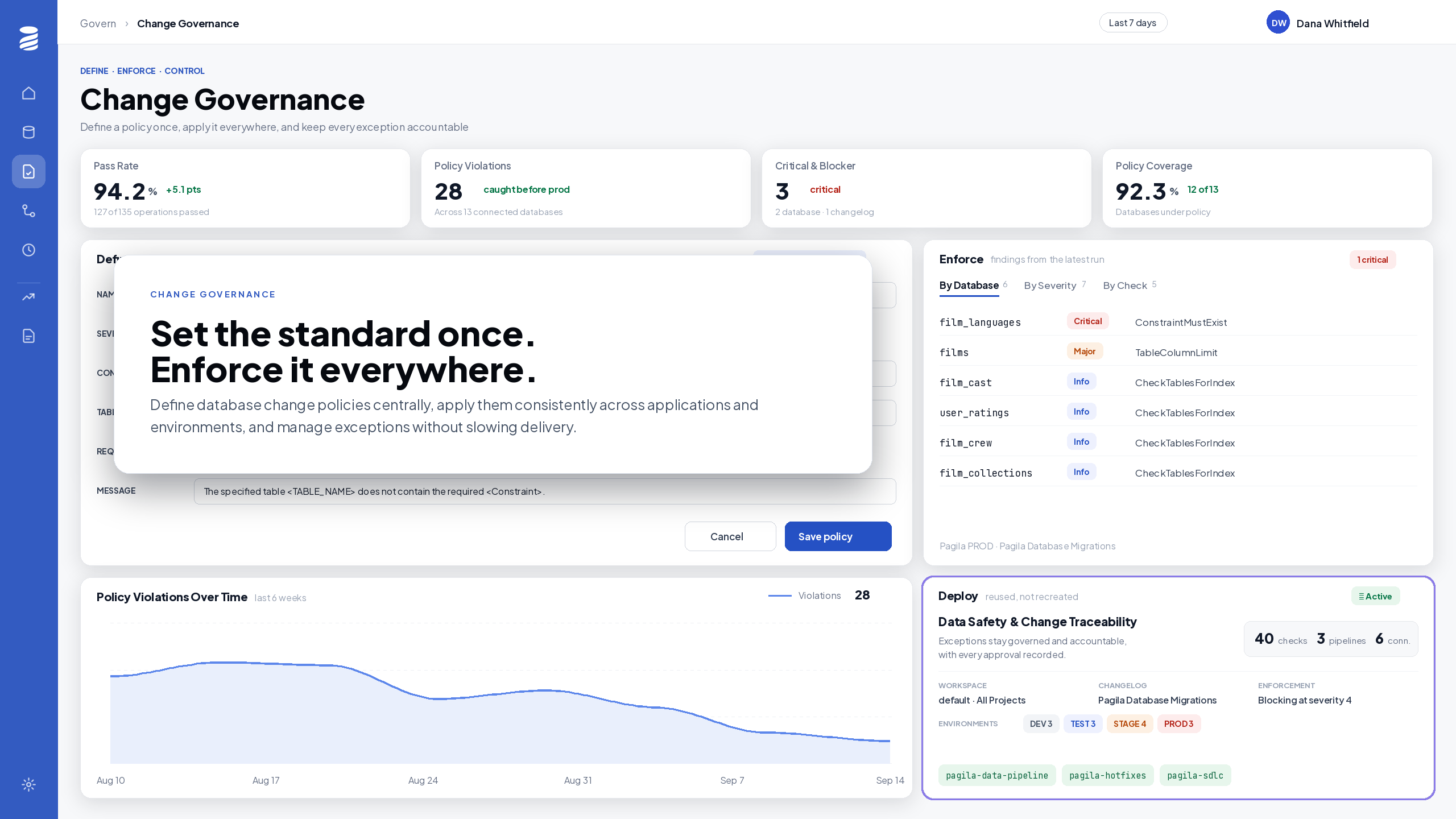
Teams can see which policies apply where, which exceptions are in place and why, and how standards are holding up without digging through configuration files or disconnected systems.
With centralized policy management, teams can:
- Build, review, and assign policies visually, without hand-editing configuration for every pipeline.
- Start with 50+ prebuilt policy rules, tune them to business requirements, and create custom policies when needed.
- Organize checks into reusable packages and assign them wherever they are needed. Update a package once, and every pipeline using it receives the change.
- Scope and document legitimate exceptions while retaining the decision in the audit history, so exceptions remain human decisions rather than silent workarounds.
The result is consistency where the enterprise needs it and flexibility where teams need it. Standards hold across the organization, while teams retain room for different applications, environments, and release schedules. Routine changes, including agent-produced changes, can move without waiting on manual review.
Control who can change the rules
Enterprise governance only works when ownership is clear. Someone must decide who can create, modify, and apply the standards that govern database change, and that decision must hold up under audit. As automation and AI agents do more of the work, that ownership matters more, not less.
Liquibase Secure 6.0 introduces role-based access control for policies, assignments, exceptions, and governed assets. Groups and roles determine who administers governance, while the enterprise identity system remains the source of truth for user identity.
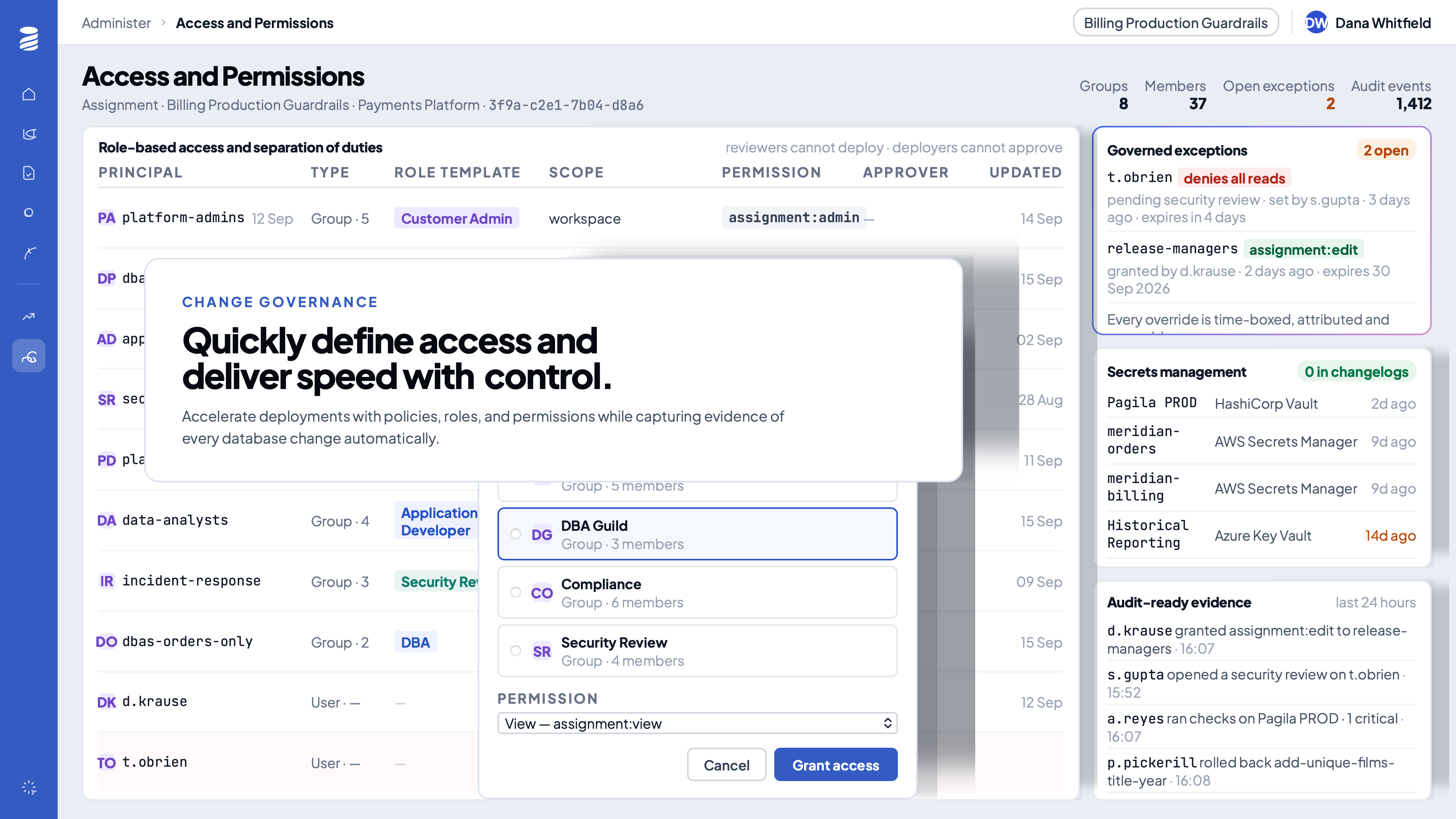
Because access control is built into the same platform as centralized policy management, the rules and the people permitted to change them are managed in one place.
With role-based access control, organizations can:
- Define who can create, modify, assign, and administer policies.
- Establish clear ownership for governed applications, environments, and other assets.
- Support separation of duties without introducing a manual approval for every database change.
Developers, and the agents working with them, retain autonomy to deliver within established guardrails. Database, platform, security, and compliance teams remain in control of how those guardrails are managed. Everyone knows who owns what, and the organization can prove it.
Faster delivery, lower risk, easier audits
Liquibase Secure 6.0 unifies Change Intelligence, Change Governance, and Change Automation in one platform for database change governance.
Teams ship faster because the rules are already in place and enforced automatically. Fewer risky changes reach production because policies apply consistently, whether a person or an AI agent authored the change. Compliance becomes easier because evidence is captured as work happens rather than reconstructed afterward.
Because 6.0 is delivered through Liquibase Secure, it builds on the automation, governance, and database coverage teams already rely on. It extends the platform enterprises have rather than adding another tool to manage.
Get started with Liquibase Secure 6.0
Liquibase Secure 6.0 is generally available now. To learn more, request a demo.
For a quick overview of the differences between the two solutions, visit our comparison matrix. We would also be happy to share the capabilities and differences in a quick call. Request a demo.
Application code can usually be redeployed when something breaks. By contrast, a database change that drops a column or rewrites data can't simply be undone. Liquibase Secure was purpose-built for the database and works across 65+ databases so teams can manage policies across all their databases from one solution.
It should do the opposite. When policies are already in place and enforced automatically, routine changes, including those from AI agents, move without waiting on manual review. Developers get guardrails instead of gates.
No. Agents can help write, test, deploy, and fix database changes, but every change is held to the same policies and tracked with the same visibility, whoever or whatever made it.
Evidence is captured automatically as work happens, including every policy change, exception, and deployment. Teams no longer have to reconstruct what happened after the fact.
We have resources linked at the bottom of this blog and there are even more details on our Docs site.

Continue reading